Plan your European Heritage Open Days visit to Connor churches
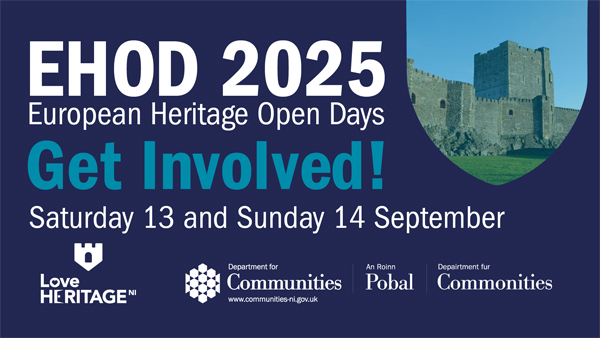
European Heritage Open Days 2025 take place across Northern Ireland on September 13 and 14, with a number of Connor churches throwing open their doors over the two days.
Below are details of the churches which will be among around 200 participating in the annual event which offers free public access to historic sites, cultural landmarks, and special events across Northern Ireland.
A packed programme of events and activities includes guided tours, talks and lectures, living history re-enactments, community fun days and more.
We include the details provided in the EHOD web listing – you can view all the ‘openers’ HERE.
————————————————————————————————–
St George’s, Belfast
St George’s Parish Church, located in High Street, Belfast, is the oldest Anglican church in use in Belfast. It is the third church to be built on that site, worship having taken place there since the 10th century if not earlier. The present building was designed by John Bowden, a Dublin architect, in the neo-Classical style then prevalent and was opened in 1816, initially to take the overflow from St. Anne’s Parish Church in Donegall Street. It became a parish church in its own right in the 1820s, serving the immediate area which until the late 19th century had a substantial resident population. The chancel was rebuilt in its present form in 1882, and the stained glass and enriching paintings reflect something of the High Church tradition of worship for which St. George’s is now well known. At the present time there are services every day, and it is a veritable oasis of peace in the heart of a busy city. The nave and narthex ( porch ) of the church have remained essentially unchanged since it was built. Notable features are the finely decorated wooden pulpit, the rood screen at the chancel steps and the marble font.
Open Saturday 10am-4pm; Sunday 1pm-4pm
————————————————————————————————–
St Patrick’s, Ballymena
Guided tour around St Patrick’s Church of Ireland including a visit to the nearby ole churchyard (Church Street) led by a professional local tour guide.
Open Saturday 10am-4pm; Sunday 2pm-4pm
————————————————————————————————–
St Stephen’s, Millfield
St Stephen’s Church, a hidden Victorian gem on Millfield in the centre of Belfast, will surprise you from the moment you walk through the door. Behind the 1960’s facade is a beautiful interior from 1869. Hear some of the history, see the biggest collection of stained glass windows created by local renowned artist Daniel Braniff and enjoy warm hospitality and refreshments. A mid-Victorian barn type church, St Stephen’s was originally constructed in 1868-69 from designs by Sir Thomas Drew (1838-1910). Drew, a Dublin-based architect but originally born in Belfast, was an apprentice to Charles Lanyon. St. Stephen’s Church of Ireland was the first new church building Drew completed as diocesan architect, his career culminating in his design for St. Anne’s Cathedral which he completed in 1904. Remarkably the church survived the Blitz of Belfast in 1941 when much of Millfield Street was demolished. Patton noted the significance of the interior of the church and records that St. Stephen’s contains ‘the finest collection in the province of stained glass by Daniel Braniff’ (Patton, p. 236). St. Stephen’s Church of Ireland was listed in 1992 and since that time has continued to be utilised as a house of worship. Patton, M., ‘Central Belfast: An historical gazetteer’ Belfast: Ulster Architectural Heritage Society, 1993. The church has a rich history, the Vestry is built over a well which served the area in Victorian times and the church hall which is now demolished was not only a space for social and spiritual activities but originally an Elementary School and in later years a base for British Forces during ‘the troubles’. Worship continues in St Stephen’s today and recent modifications have ensured that St Stephen’s Church is fit for modern day worship and ministry.
Open Saturday 10am-3.30pm
————————————————————————————————–
All Saints’, Eglantine
Built in 1875, this B1 listed church was designed by the architect Sir Thomas Drew and was built by the Mulholland family in memory of St Clair Kelburn Mulholland.
St Clair was one of five brothers who founded the York Street spinning mills in Belfast. When he died, his daughter Mary Filgate Mulholland decided to build this private chapel in his memory. The Mulholland family helped to maintain this church, providing a sexton’s house, a schoolhouse at Newport and a Rectory.
The church became part of the then Diocese of Down, Connor and Dromore in 1916 and has been in use as a parish church ever since. The founder of the Ulster Architectural Society Sir Charles Brett believes that All Saints’ is the finest ever designed by Thomas Drew, built in a distinctly English style with walls of black stone and small red roof tiles. The interior is particularly ornate with a apsidal sanctuary lined with encaustic tiles. Brett tells us that Sir Thomas Drew (1838-1910) worked for Charles Lanyon and designed many churches throughout Ulster, before being appointed as diocesan architect of Down, Connor and Dromore in 1865. He was knighted in 1900 as part of the Queen’s birthday honours.
The Mulholland’s are buried in the family plot in the grounds of the church. A parish graveyard came into existence in the 1920’s and it contains 21 Commonwealth War graves.
Open Saturday 10am-4pm; Sunday 2pm-4pm
————————————————————————————————–
St Nicholas, Carrickfergus
Founded by the Anglo-Norman knight John de Courcy in 1182 shortly after his development of Carrickfergus Castle, St. Nicholas Church is unique within Ulster and has survived as a place of worship for over 800 years. Located in the heart of the town just 200 metres from Carrickfergus Castle, an iconic symbol of Northern Ireland’s medieval heritage, the church retains many Norman features such as columns and piscina.
Visitors can explore the church’s history through ghost marks, showcasing its evolution from the 1305 enlargement by Robert de Mercer to extensive 17th-century renovations commissioned by Sir Arthur Chichester who was instrumental in the development and expansion of Belfast. The Chichester Memorial, an impressive Jacobean funereal monument, features marble and alabaster bearing the effigies of Sir Arthur, his wife Lady Lettice, and their tragically short-lived son, Arthur.
The church reveals intriguing elements such as the Priest’s Door, believed to be the entrance for monks’ daily services, and medieval graveslabs dating back to the 12th century. Art enthusiasts can admire stained glass from An Tur Gloine Studio, Dublin, including works by Ethel Rhind, Beatrice Elvery, and Catherine O’Brien.
St. Nicholas’s Church boasts literary connections, with (Frederick) Louis MacNeice’s father serving as rector and Jonathan Swift appointed prebendary in 1695. Swift played a vital role in church administration and pastoral care.
Today, St. Nicholas’s Church remains a beloved place of worship and stands as a living testament to centuries of history, offering a glimpse into Carrickfergus’s rich cultural and religious past.
Open Saturday 10am-4pm; Sunday 1pm-4pm
————————————————————————————————–
St Matthew’s, Shankill
St Matthew’s Church is known for its ultra Hibernian style. Built between 1869 – 1872 the church is built in the shape of a Shamrock and has a steeple in the form of an Irish round tower. The church is sited close to Shankill Graveyard and the Church Hall is on the Farset River close to the site of the original ancient White Church which gave Shankill its name. The Church is architecturally unique and has the Balluan Stone in the grounds. The stone was found in the graveyard and moved to the church 1910 – believed to have been used as a baptismal font in early Christian times.
Open Saturday 10am-4pm; Sunday 1pm-4pm
————————————————————————————————–
St Patrick’s, Cairncastle
St Patrick’s Church of Ireland is located on Ballymullock Road, near Cairncastle, and looks down onto the scenic Ballygally bay. A place of antiquity, and still an active centre of worship,
St Patrick’s was the site of a medieval church appearing in the papal taxation of 1306 as Karkastell. The ancient medieval graveyard includes the remains of the famous Spanish Armada tree and an offspring of the same.
Open Saturday 1pm-5pm; Sunday 1pm-5.30pm
————————————————————————————————–
Craigs’ Parish Church
Nestled in the heart of what the Ulster Scots call God’ Acre, in the middle of what was a thriving Linen industry area. Craigs Parish Church was designed by Charles Lanyon in around 1841. Boasting a beautiful historic Parochial Hall opposite the church. In the adjoining Graveyard we have one of Northern Ireland’s largest Famine graves, a commonwealth war grave and a rector who was a Military Cross war hero. Craigs parish church itself has had starring roles on TV such as Derry Girls and Three Families.
Open Saturday & Sunday 11am-4pm
————————————————————————————————–
Gartree Parish Church
Visit the recently refurbished 19th Century church with its private family pew located in the grounds of Langford Lodge which also acted as Northern Ireland Base Command for United States troops during World War 2.
For European Heritage Open Days, Gartree Parish Church will be open and there will be WWII enactors and memorabilia throughout the event.
Open Satruday 10am-4pm; Sunday 9am-1pm
————————————————————————————————–
Ballintoy Parish Church
This church is perched on a hill above Ballintoy Harbor in one of the most scenic locations on the north Antrim coastline. Rathlin Island and parts of the Scottish coastline can be seen out to sea as well as the stunning white cliffs as a backdrop. The steeple from this church was removed after being damaged by a hurricane that struck the north coast in December of 1894. Part of it crashed through the church roof, headstones were blown over and broken, houses in the village were severely damaged and in some cases demolished, stacks in the fields where scattered and several thatched cottages in the district caught fire and burned.
At the harbour, several boats were destroyed and the sea washed around O’Roarke’s cottage (now O’Roarke’s Kitchen) to a depth of four feet. Inside the church are two beautiful stained glass windows, one depicts Saint Patrick at Slemish mountain, on the wall inside is a plaque to David Elder Jamieson who lost his life aboard HMS Defence at the Battle of Jutland, in the graveyard are the war graves of sailors lost from HMS Racoon and HMS Viknor during the First World War. If you look on the side of the church you will see another unique feature, a sundial which dates to 1817 and was used to record the movements of the tides.
Around 1760 the estate and castle was purchased by Alexander Fullerton who left the estate to his niece with the proviso that the Fullerton surname be retained, hence the Fullerton Arms in the village. On her marriage to Dawson Downing, the Downing-Fullerton surname came into being. A relative of her husband Sir George Downing is remembered in the naming of Downing Street in London, the seat of the government. The castle was demolished in 1795 with the oak panelling, staircase, beams and fittings being re-used in Downing College, Cambridge. Many notable landed families appear on the names of the gravestones here. These include the Stewarts of Ballintoy, Downing Fullerton, and the Stewart-Moore family. The Reverend Robert Trail who died in 1842 and is buried in the graveyard was the longest serving Minister of Ballintoy Church having been here for 66 years. The area was recently used as the backdrop for filming scenes for the global smash hit fantasy series ‘Game of Thrones’.
(As described by the National Churches Trust).
Open Saturday 10am-6pm; Sunday 1pm-6pm
————————————————————————————————–
St Anne’s Cathedral, Belfast
Belfast Cathedral, also known as the Cathedral Church of St. Anne, has stood for over 100 years in the heart of Belfast – a treasure trove of art, culture and music. The foundation stone of the Cathedral was laid in 1899 and the building itself, Romanesque in style, continued to grow over the years. The 40-meter stainless steel Spire of Hope was added in 2007. The Cathedral contains detailed mosaics by the sisters Gertrude and Margaret Martin, elaborate stonework by Rosamond Praeger, Morris Harding and Esmond Burton, beautiful stained glass windows and more. Visitors to St Anne’s Cathedral can learn about its history and unique features by browsing our high quality guidebook. As one of the top visitor attractions in Belfast city centre, step inside and enjoy the peaceful and beautiful interior as you discover the treasures of St Anne’s.
The InSpire Kids Trail is available for schools and families, as well as the Women’s Tour which highlights the incredible work of the women of the Cathedral over the years. Visitor Guides and state of the art Audio Guides are available in eight languages, English, French, German, Italian, Spanish, Polish, Portuguese, and Mandarin Chinese.
Keep an eye on our social-media and website for more information on what to expect this EHOD.
Open Saturday 10.30am-4pm
————————————————————————————————–
Kilbride Parish Church
Kilbride Parish Church will be taking part in this year’s European Heritage Open Days (EHOD) and visitors are invited to look around this beautiful country church, located near Doagh, Co. Antrim, and learn something of its history. The church, known as St Bride’s, has been an Anglican centre of worship for the village of Doagh and its surrounding area since 1868. It was consecrated on 9 June, 1868 only a short time before the disestablishment of the Church of Ireland in 1871.
St Bride’s was built in an English architectural style with many beautiful stained glass windows, some dating back to its original construction, and an original organ built by William Hill of London, who also supplied the first organ in the Ulster Hall in Belfast.
Visitors can avail of a guided tour of the building or are free to browse at their own leisure. If anyone would like to attend our Service of Morning Prayer on the Sunday morning prior to looking round the church they would be made very welcome. There will be a Holy Baptism during the service that morning.
Open Saturday 10am-4pm; Sunday 1pm-4pm
————————————————————————————————–
If your church is opening for EHOD and we have inadvertently missed including you in this list, please contact dco@connordiocese.org and we will rectify the omission.


Site Directory
- Home
- All Aboard Year 3 Resources
- Cookie Policy
- Privacy Policy
- About us
- News
- Parishes
- Agherton
- Ahoghill and Portglenone
- Antrim
- Ardclinis, Tickmacrevan, Layde and Cushendun
- Armoy, Loughguile and Drumtullagh
- Ballinderry
- Ballintoy, Dunseverick and Rathlin
- Ballymacash
- Ballymena (Kilconriola) and Ballyclug
- Ballymoney, Finvoy and Rasharkin
- Ballynure and Ballyeaston (Ballyclare)
- Ballyrashane & Kildollagh
- Ballywillan, Portrush
- Belfast Cathedral
- Billy & Derrykeighan
- Blackstaff Mission Area
- Broomhedge
- Carnmoney
- Carrickfergus
- Christ Church, Lisburn
- Cloughfern
- Coleraine
- Connor and Antrim St Patrick
- Craigs, Dunaghy and Killagan
- Derriaghy
- Derryvolgie
- Drummaul, Duneane and Ballyscullion
- Dunluce
- Dunmurry
- Eglantine
- Finaghy and Upper Malone
- Glenavy
- Glencairn
- Greenisland
- Holy Trinity and St Silas with Immanuel
- Jordanstown
- Kilbride
- Kilmakee Parish
- Kilroot and Templecorran
- Kilwaughter and Cairncastle with All Saints Craigyhill
- Lambeg
- Larne & Inver, Glynn & Raloo
- Lisburn Cathedral
- Lisburn St Paul’s
- Magheragall
- Mallusk
- Malone
- Monkstown
- Mossley
- Muckamore and Killead
- Ramoan and Culfeightrin (Ballycastle)
- Rathcoole
- Saint Katharine
- Skerry, Rathcavan & Newtowncrommelin
- St Bartholomew’s, Stranmillis
- St George’s
- St Mark (Ballysillan)
- St Mary with Holy Redeemer
- St Matthew’s, Shankill
- St Michael Belfast
- St Paul & St Barnabas
- St Peter & St James
- St Stephen and St Luke (Lower Falls)
- St Thomas’s
- Stoneyford and Gartree
- Templepatrick and Donegore
- The United Parishes of St Nicholas and All Saints
- Upper Falls
- Whitehead & Islandmagee
- Whitehouse St Ninian
- Whiterock
- Woodburn
- Children/Youth
- Support
- Gallery
- Connor Connections
- Vacancies
- Links
Follow us online
© Copyright The Church of Ireland Diocese of Connor 2026 | Web Design by LD2.digital