Hospital chaplain interviewed for Palliative Care Week
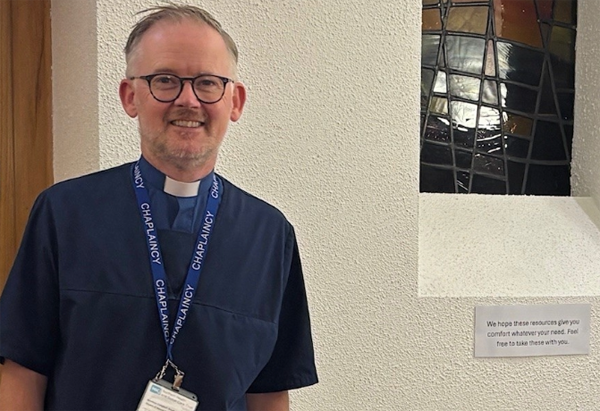
The Rev Jonny Campbell-Smyth, chaplain in Antrim Area Hospital.
The Rev Jonny Campbell-Smyth, rector in Ballynure and Ballyeaston (Ballyclare), was interviewed by the Northern Health and Social Care Trust during Palliative Care Week.
Jonny is Hospital Chaplain in Antrim Area Hospital, and chaplaincy service representative on the on the Trust’s Palliative Care Group.
The interview covered areas including what motivated Jonny to become a hospital chaplain and the day-to-day aspects of the job, and you can read the interview in full below.
Learn more about the work of a chaplain HERE.
What motivated you to pursue a career as a Chaplain within the Northern Trust?
I would consider my role to be more of a calling than a job, and that comes from a desire to support and care for people in need. The role of a church minister often spans many different responsibilities, and sometimes you can lose sight of my calling, but the role of a Chaplain allows me to come alongside people who need to know they matter. My weekly chaplaincy duties are part-time, but every week they bring me back to what really matters in life, and that is relationships with people.
What does your job entail /what does a typical day look like in your role?
My role, like all chaplains in the Northern Trust, is part-time. I work two mornings per week, but every day is different because I never know what situations I will face. I can be in any part of the hospital – from ICU, to maternity, to the emergency department. I also have the privilege of being a chaplain to patients, families and staff. Some people simply want to talk through their feelings, some people need the assurance of prayer, and some people need comfort with the trauma that they are facing. Some patients I will only see once because they’ve been discharged from the hospital, and there will be others who I will pop in and see sometimes for months building deep relationships with them. At the end of each session I drive away from the hospital hoping that I have made a difference to a person’s situation.
What is your favourite thing about your job?
It is such a privilege to come alongside patients and their families who have real needs. It makes me so appreciative for my own good health.
What did you want to be when you grew up?
Probably like many young boys, the idea of being a fighter pilot was on the list. However at an early age I remember an older woman telling my mother that she prayed one day I would serve God in some way. Her prayers were answered.
What aspect of your work do you find most rewarding and how does it resonate with your personal values and mission?
The issue of calling has followed me for many years, which is why I left a successful consultancy job, and retrained for full-time ministry. Therefore, I am rewarded every day that I now get to spend time supporting people with real issues. I’ve made myself available to people irrespective of their faith or no faith, and the reward comes in seeing how people’s values and beliefs are another aspect of the healing process.
What are you most proud of in your career or can you highlight a particular achievement that you are particularly proud of and why?
As a chaplaincy team we are regularly involved in the Trust’s Paediatric Burial service. This a particularly traumatic time for the many families that have lost babies. It is a deep privilege to work with the Bereavement Support Midwife to provide support to families in their loss.
Do you work with any other teams in the Trust/how does your work link with other teams in the Trust?
As the Chaplaincy team reaches into every hospital ward, we work with many professionals. We also work closely with the Bereavement Co-ordinator and Palliative Care teams in specific Trust initiatives.
What does being a part of Team North mean to you?
Although the Chaplaincy Team is mainly a part-time provision, we hope on a daily basis that we have opportunity to show compassion to anyone we meet – patients, families, and staff, and reflect the ethos of Team North.
Could you share a significant challenge you’ve faced in your role and how you overcame it to provide quality care services?
The demand on the chaplaincy service has increased in recent times, and therefore as a team we have been trying to create useful resources for patients and families to access, and then link in with teams or specific wards to ensure those most in need can access our care.
How do you ensure the delivery of compassionate and effective care in your specific healthcare discipline?
I’ve previously felt the need to visit as many patients as possible during my session, but I’ve realised that chaplaincy must be about presence rather than production. You cannot put a timeline on a patient encounter, because you don’t know what issues they wish to share. I’m also aware of being part of a wider care team, and therefore with the introduction of Encompass we now have more opportunity to communicate and collaborate with the other staff in the overall care of the patient.
How do you manage the demands of your job and what strategies do you employ to ensure exceptional healthcare service delivery?
I think the reality of a role that is only 7.5 hours per week means that I have to set realistic and healthy expectations. It will never be possible to see every patient, but each session begins with me asking God to direct me to people who He wants me to connect with. That’s not a strategy that you are going to find in any management or leadership book, but this for me is a calling not a job, and God doesn’t let me down. I also actively build relationships with staff in the wards so that they can often direct me to people they know who require chaplaincy support.
Have there been any mentors or colleagues who have significantly influenced your work, and in what way?
The specialist Palliative Care Chaplain in Antrim Hospital has been an incredible support to me. He is an incredible encourager, always asking me first about how I am, before we discuss matters specific to our jobs.
What are your aspirations for the future, and how do you envision the evolution of your role within the Northern Trust?
My desire for the future is that I remain grounded in my role to humbly serve people whatever their belief system. With the introduction of encompass the Chaplaincy Service has become more visible, so my hope would be that I am able to be more integrated with other disciplines in the holistic care of patients.
How do you believe your efforts contribute to the overall excellence and advancement of healthcare services?
Every day brings new encounters – some happy ones and some incredibly sad. But in all I do, often not perfect, I hope I display virtues of compassion and honesty with everyone I meet. I am grateful to God for the opportunities that come my way.

Site Directory
- Home
- All Aboard Year 3 Resources
- Cookie Policy
- Privacy Policy
- About us
- News
- Parishes
- Agherton
- Ahoghill and Portglenone
- Antrim
- Ardclinis, Tickmacrevan, Layde and Cushendun
- Armoy, Loughguile and Drumtullagh
- Ballinderry
- Ballintoy, Dunseverick and Rathlin
- Ballymacash
- Ballymena (Kilconriola) and Ballyclug
- Ballymoney, Finvoy and Rasharkin
- Ballynure and Ballyeaston (Ballyclare)
- Ballyrashane & Kildollagh
- Ballywillan, Portrush
- Belfast Cathedral
- Billy & Derrykeighan
- Blackstaff Mission Area
- Broomhedge
- Carnmoney
- Carrickfergus
- Christ Church, Lisburn
- Cloughfern
- Coleraine
- Connor and Antrim St Patrick
- Craigs, Dunaghy and Killagan
- Derriaghy
- Derryvolgie
- Drummaul, Duneane and Ballyscullion
- Dunluce
- Dunmurry
- Eglantine
- Finaghy and Upper Malone
- Glenavy
- Glencairn
- Greenisland
- Holy Trinity and St Silas with Immanuel
- Jordanstown
- Kilbride
- Kilmakee Parish
- Kilroot and Templecorran
- Kilwaughter and Cairncastle with All Saints Craigyhill
- Lambeg
- Larne & Inver, Glynn & Raloo
- Lisburn Cathedral
- Lisburn St Paul’s
- Magheragall
- Mallusk
- Malone
- Monkstown
- Mossley
- Muckamore and Killead
- Ramoan and Culfeightrin (Ballycastle)
- Rathcoole
- Saint Katharine
- Skerry, Rathcavan & Newtowncrommelin
- St Bartholomew’s, Stranmillis
- St George’s
- St Mark (Ballysillan)
- St Mary with Holy Redeemer
- St Matthew’s, Shankill
- St Michael Belfast
- St Paul & St Barnabas
- St Peter & St James
- St Stephen and St Luke (Lower Falls)
- St Thomas’s
- Stoneyford and Gartree
- Templepatrick and Donegore
- The United Parishes of St Nicholas and All Saints
- Upper Falls
- Whitehead & Islandmagee
- Whitehouse St Ninian
- Whiterock
- Woodburn
- Children/Youth
- Support
- Gallery
- Connor Connections
- Vacancies
- Links
Follow us online
© Copyright The Church of Ireland Diocese of Connor 2026 | Web Design by LD2.digital