Gaza famine: Christian Aid responds to humanitarian catastrophe
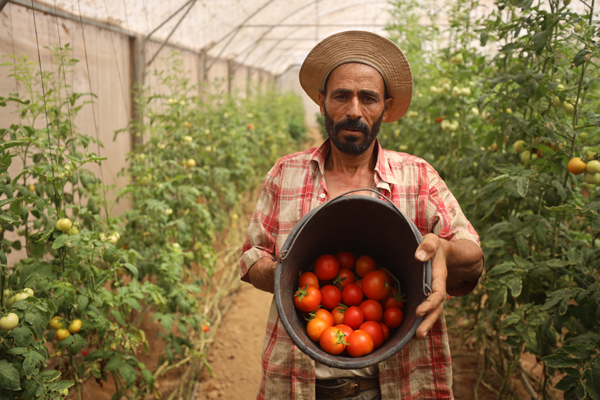
Imad Al-Muanni shows off some of the tomatoes he has grown in his greenhouse in Gaza, with support from Christian Aid. Credit: Majdi Fathi/Christian Aid
In response to the situation in Gaza, Christian Aid says most border crossings into Gaza remained closed following the fragile ceasefire that took effect on October 10, with aid deliveries falling catastrophically short of what’s required.
The charity is appealing for your support to respond to the famine in Gaza. The appeal reads:
The situation on the ground remains one of profound humanitarian emergency with acute shortages of food, clean water, medical care and safe shelter. Many families returned to the rubble of their former homes only to find a wasteland of destruction.
In August, famine was confirmed in Gaza – not the result of a natural disaster but a man-made famine, caused by Israel’s blockade, which prevented all but a trickle of desperately needed food, water and medical supplies from entering the territory.
But even while thousands of lorries full of vital aid remain stuck at Gaza’s border crossings, hampering the efforts of many aid agencies, Christian Aid continues to make cash transfers to its trusted partners inside the strip who are responding to the needs of communities on the ground.
Thanks to the compassion and generosity of Christian Aid’s supporters over the past two years, the charity’s partners inside Gaza have been able to respond to the crisis, reaching those in greatest need with food, clean water, medical care, education and safe shelter. Over the past two years, Christian Aid’s partners have worked tirelessly for the people in Gaza by providing food, shelter and medical support, reaching over 900,000 people. Donations made by Christian Aid supporters – people like you – have saved lives.
The charity’s local partners have responded in the following ways since October 2023:
Emergency food and water: Christian Aid’s partners have distributed fresh food parcels and hot meals daily, with some produce grown in home gardens and urban plots. The charity’s partner, the Palestinian Agricultural Development Association (PARC) is helping displaced families grow vegetables between tents, preserving heirloom seeds, harvesting local crops and using solar-powered wells to supply clean water.
Mobile health and psycho-social care: Mobile clinics operated by Christian Aid’s partner, the Palestinian Medical Relief Society (PMRS) have provided urgent care across Gaza, treating injuries, supporting pregnant women and the elderly, and offering psycho-social support to traumatised children. With fuel supplies nearly depleted, doctors cycle between locations to reach those in need.
Safe shelter and protection: Christian Aid’s partner, the Culture and Free Thought Association (CFTA) has transformed community centres into safe shelters, providing displaced families with food, bedding, hygiene kits and a sense of protection, all coordinated by local volunteers.
Education for displaced children: With schools destroyed, displaced teachers and volunteers are running makeshift classrooms inside shelters, helping children continue their education. Christian Aid’s partners support hundreds of children each week with informal lessons and psycho-social care, restoring a sense of normality in uncertain times.
Empowering women in crisis: Women-led organisations such as the Women’s Affairs Centre (WAC) have provided widows and female-headed households with hygiene kits, legal aid and trauma counselling. Some women have launched tailoring workshops to repair clothing, a vital service when new goods can’t enter Gaza. Others run solar-powered digital hubs, offering online training and remote employment opportunities so that women can support their families.
Community-led responses: Christian Aid’s partners equip local volunteers to identify and meet ongoing needs, from fixing water points to constructing accessible shelters for people with disabilities. These local initiatives have become the backbone of Gaza’s humanitarian response.
This work is more than aid. It’s an act of solidarity, dignity and survival.
Christian Aid has worked in the region for over 60 years and supports 16 local partners across Gaza, the West Bank, Israel and Lebanon. In Gaza, these partners include:
- Palestinian Agricultural Development Association (PARC) – Supporting urban food production, water access and family farming.
- Culture and Free Thought Association (CFTA) – Providing shelters, education and psycho-social care for displaced families.
- Women’s Affairs Centre (WAC) – Support for widows and women-led households, digital livelihoods and legal aid.
- Palestinian Medical Relief Society (PMRS) – Providing mobile medical teams and maternal health services.
- Palestinian NGO Network (PNGO) – Civil society coordination and policy advocacy.
- Palestinian Centre for Human Rights (PCHR) – Providing legal aid and monitoring and documenting human rights abuses to provide accountability and justice for victims.
Please support Christian Aid’s work to respond to the famine in Gaza. To make a donation, please visit caid.ie/GazaAppeal or to donate by telephone, please call 028 9064 8133. Cheques can be posted to Christian Aid Ireland, 96 Beechill Road, Belfast, BT8 7QN. Thank you.
 Growing food in Gaza
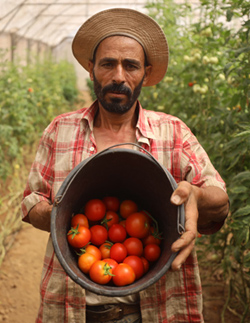
Every morning, Palestinian farmer Imad Al-Muanni travels by donkey and cart to his tomato farm in Deir al-Balah, central Gaza. The 40-year-old is accompanied by his wife, son and sister. They work together, tending to their tomatoes and harvesting them.
Imad and his family have been displaced three times since the war started. He said: “I rely on my greenhouse as a source of income for myself and my family. The greenhouse is not far from my home and I spend long hours here to maintain a good harvest and sell my tomatoes in the local market. I received fertilizer [from Christian Aid’s partner] to ensure the success of my crop.”
The Israeli blockade of Gaza has impacted Imad’s farm business, as he explained: “It’s difficult to get water to irrigate the crops. I buy diesel at a high price to operate the generator that pumps water from underground wells. I dream of having solar energy to obtain water at a lower cost. This would also help reduce vegetable prices in the market.”
As famine continues to unfold in Gaza, and starvation has claimed the lives of hundreds of people, Christian Aid’s local partner, the Palestinian Agricultural Development Association (PARC) is supporting Imad and other farmers to grow food desperately needed by everyone across the territory.


Site Directory
- Home
- All Aboard Year 3 Resources
- Cookie Policy
- Privacy Policy
- About us
- News
- Parishes
- Agherton
- Ahoghill and Portglenone
- Antrim
- Ardclinis, Tickmacrevan, Layde and Cushendun
- Armoy, Loughguile and Drumtullagh
- Ballinderry
- Ballintoy, Dunseverick and Rathlin
- Ballymacash
- Ballymena (Kilconriola) and Ballyclug
- Ballymoney, Finvoy and Rasharkin
- Ballynure and Ballyeaston (Ballyclare)
- Ballyrashane & Kildollagh
- Ballywillan, Portrush
- Belfast Cathedral
- Billy & Derrykeighan
- Broomhedge
- Carnmoney
- Carrickfergus
- Christ Church, Lisburn
- Cloughfern
- Coleraine
- Connor and Antrim St Patrick
- Craigs, Dunaghy and Killagan
- Derriaghy
- Derryvolgie
- Drummaul, Duneane and Ballyscullion
- Dunluce
- Dunmurry
- Eglantine
- Finaghy and Upper Malone
- Glenavy
- Glencairn
- Greenisland
- Holy Trinity and St Silas with Immanuel
- Jordanstown
- Kilbride
- Kilmakee Parish
- Kilroot and Templecorran
- Kilwaughter and Cairncastle with All Saints Craigyhill
- Lambeg
- Larne & Inver, Glynn & Raloo
- Lisburn Cathedral
- Lisburn St Paul’s
- Magheragall
- Mallusk
- Malone
- Monkstown
- Mossley
- Muckamore and Killead
- Ramoan and Culfeightrin (Ballycastle)
- Rathcoole
- Saint Katharine
- Skerry, Rathcavan & Newtowncrommelin
- St Aidan and St Mary Magdalene
- St Bartholomew’s, Stranmillis
- St George’s
- St Mark (Ballysillan)
- St Mary with Holy Redeemer
- St Matthew’s, Shankill
- St Michael Belfast
- St Paul & St Barnabas
- St Peter & St James
- St Simon and St Philip (Drew Meml)
- St Stephen and St Luke (Lower Falls)
- St Thomas’s
- Stoneyford and Gartree
- Templepatrick and Donegore
- The United Parishes of St Nicholas and All Saints
- Upper Falls
- Whitehead & Islandmagee
- Whitehouse St Ninian
- Whiterock
- Woodburn
- Children/Youth
- Support
- Gallery
- Connor Connections
- Vacancies
- Links
Follow us online
© Copyright The Church of Ireland Diocese of Connor 2026 | Web Design by LD2.digital