A Church for the Nations: Learning from North Africa
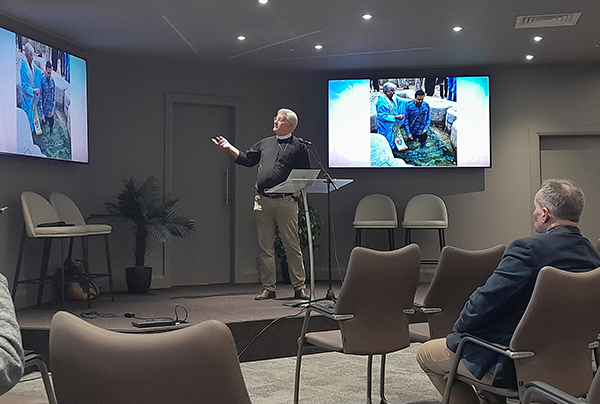
The Rev Frank Bernardi addresses the Council for Mission’s conference on being a Church for the nations, in Lisburn on Thursday February 12.
- Online event on Tuesday (17th February) to share this story of blessing
“God wants to bless us so we can be a blessing to every nation on Earth,” the Rev Frank Bernardi remarked as he addressed the Council for Mission’s conference on being a Church for the nations, in Lisburn on Thursday February 12.
Mr Bernardi, the rector of St George’s Church, Tunis, is visiting Ireland as the guest of the Council for Mission. With growing congregations of English and Arabic speakers, St George’s forms part of the Anglican Province of Alexandria which takes in most of North Africa. The Council is grateful to Mr Alan Cousins, from the broadcasting agency SAT-7, for his extensive work in organising the schedule for what has been a very encouraging time.
His first talk at the morning event took listeners through Scripture’s promises of personal blessing so that believers – from Abraham onwards – will bless others, as part of the covenant between God and his people. He drew attention to biblical terms that can help the Church to better understand its mission today:
- ethnae – the Greek word for people groups with a distinct ethnicity and language (ethno-linguistic groups)
- goyem – the root word in Hebrew for Gentile which refers to all people ‘who are not’ similar to the person speaking or writing the word
It is significant that some of those listed in Matthew’s genealogy of Jesus came from non-Israelite backgrounds and that the first people to encounter Jesus and his family in Matthew’s Gospel were outsiders – the shepherds and the Magi.
“The plan of redemption is not just to save the world from its sins,” he noted, “but it’s to bring redemption to every nation, every ethnic group, every family on Earth.”
In his second talk, he recalled the history of St George’s as a church planted by Anglicans in colonial times which is now becoming a ‘truly indigenous and authentic’ church of North African for North Africans.
The early Church in North Africa persevered amid persecution, which recurred in phases in Roman times, and its leadership in Carthage included Tertullian and Cyprian. It was known for taking a stand against believers who renounced their faith under persecution (known as lapsi), a willingness for martyrdom, and generous care for the poor and the sick. However, after Christianity became tolerated in the Edict of Milan (310AD), the Church declined amid theological and cultural divisions – well before the region was mainly converted to Islam.
Tunisia benefits from greater religious freedom than surrounding countries and has been known as a trend-setter within the region from the times of the Phoenicians onwards. Mr Bernardi commented: “For 1,500 years, the blessing of Carthage was dormant, but God is starting to return that blessing.”
Tomorrow, a Middle East Prayer Walk will be displayed in St Mary and St John’s Cathedral, in Sligo, and Mr Bernardi will speak at the Cathedral’s morning service at the invitation of Bishop Ferran Glenfield.
Please read on to find out about an opportunity for everyone with an interest in mission and how we can learn about growth and reaching the nations from this encouraging narrative in North Africa.
Tunisia in your living room
Join us for a special online event on Tuesday evening
Readers who have not had the opportunity to attend in-person events with Frank organised by the Council for Mission and our dioceses are welcome to journey with us to North Africa and to enjoy the remarkable story of the Church today and to be surprised by God.
When? Tuesday, 17th February 2026, at 7.30pm
Please click on this link and enjoy, as we listen and pray together.
Instructions for joining are available here
If you have any questions, please contact the organiser – Alan Cousins (SAT-7) – by email at acousins@sat7uk.org

Site Directory
- Home
- All Aboard Year 3 Resources
- Cookie Policy
- Privacy Policy
- About us
- News
- Parishes
- Agherton
- Ahoghill and Portglenone
- Antrim
- Ardclinis, Tickmacrevan, Layde and Cushendun
- Armoy, Loughguile and Drumtullagh
- Ballinderry
- Ballintoy, Dunseverick and Rathlin
- Ballymacash
- Ballymena (Kilconriola) and Ballyclug
- Ballymoney, Finvoy and Rasharkin
- Ballynure and Ballyeaston (Ballyclare)
- Ballyrashane & Kildollagh
- Ballywillan, Portrush
- Belfast Cathedral
- Billy & Derrykeighan
- Blackstaff Mission Area
- Broomhedge
- Carnmoney
- Carrickfergus
- Christ Church, Lisburn
- Cloughfern
- Coleraine
- Connor and Antrim St Patrick
- Craigs, Dunaghy and Killagan
- Derriaghy
- Derryvolgie
- Drummaul, Duneane and Ballyscullion
- Dunluce
- Dunmurry
- Eglantine
- Finaghy and Upper Malone
- Glenavy
- Glencairn
- Greenisland
- Holy Trinity and St Silas with Immanuel
- Jordanstown
- Kilbride
- Kilmakee Parish
- Kilroot and Templecorran
- Kilwaughter and Cairncastle with All Saints Craigyhill
- Lambeg
- Larne & Inver, Glynn & Raloo
- Lisburn Cathedral
- Lisburn St Paul’s
- Magheragall
- Mallusk
- Malone
- Monkstown
- Mossley
- Muckamore and Killead
- Ramoan and Culfeightrin (Ballycastle)
- Rathcoole
- Saint Katharine
- Skerry, Rathcavan & Newtowncrommelin
- St Bartholomew’s, Stranmillis
- St George’s
- St Mark (Ballysillan)
- St Mary with Holy Redeemer
- St Matthew’s, Shankill
- St Michael Belfast
- St Paul & St Barnabas
- St Peter & St James
- St Stephen and St Luke (Lower Falls)
- St Thomas’s
- Stoneyford and Gartree
- Templepatrick and Donegore
- The United Parishes of St Nicholas and All Saints
- Upper Falls
- Whitehead & Islandmagee
- Whitehouse St Ninian
- Whiterock
- Woodburn
- Children/Youth
- Support
- Gallery
- Connor Connections
- Vacancies
- Links
Follow us online
© Copyright The Church of Ireland Diocese of Connor 2026 | Web Design by LD2.digital