Christian Aid Ireland’s Harvest appeal focuses on South Sudan
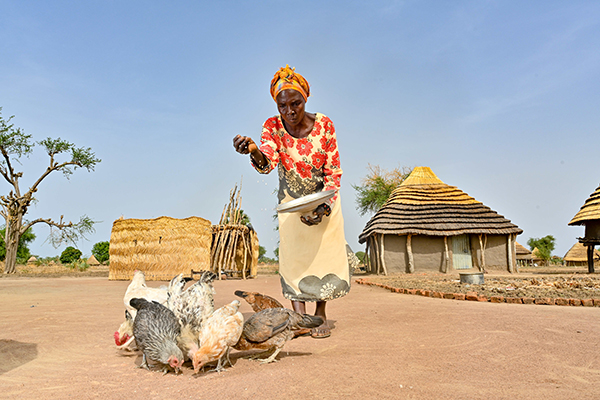
Anok Angok Kon feeding her chickens near her home. Credit: Christian Aid/David Macharia
Christian Aid Ireland’s Harvest appeal this year focuses on South Sudan, where harvests are threatened by climate change – especially heatwaves and flooding
Until recently, Connor Diocese was in a long-term partnership with the Diocese of Yei in South Sudan, and lasting friendships were formed with people from that country.
In launching this year’s Harvest appeal, Christian Aid Ireland is sharing the story of Anok Angok Kon, who lives in South Sudan with her husband and their seven children on the frontline of a climate crisis they had no part in creating.
This is the story – and the appeal:
Harvest has long been an important and much-loved time for Christians. In this season, we come together to give thanks for God’s blessings and to share what we have. We collect food from our kitchen tables and give generously to support neighbours and good causes. For many of us, Harvest is also a time to remember our global sisters and brothers, living through crises that rarely make the news headlines.
In many of the world’s poorest countries, the climate crisis is making it more difficult for farming families to grow food to support themselves.
In South Sudan, which is among the very poorest countries in the world, most families rely on farming to survive but the climate crisis has made the seasons unpredictable. Delayed rains, dangerously high temperatures and devastating floods leave many struggling to feed their children. On top of that, decades of conflict have resulted in repeated cycles of displacement, with families forced to flee their homes and abandon their farmland time and time again.
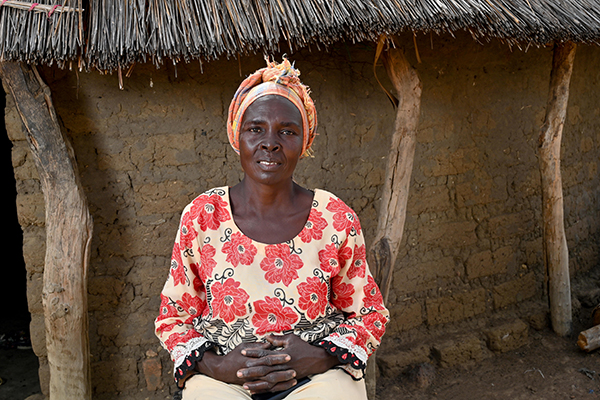
Anok Angok Kon near her home in Aweil West County, Northern Bahr el Ghazal state, South Sudan. Credit: Christian Aid/David Macharia
In the north-west of the world’s youngest country, Anok Angok Kon lives with her husband and their seven children, on the frontline of a climate crisis they had no part in creating. Theirs is a low-lying region and every year, during the rainy season, heavy rainfall accumulates and flood waters sweep through their village, damaging homes, destroying harvests and killing livestock.
Anok recalls the day when flood waters swept through her village, killing all her precious livestock – animals she relies on to make her living. Like many farmers, she feared what the future would hold for her children.
Anok says that when harvests are destroyed by flood waters, there isn’t enough food to go around and ‘all are vulnerable.’
Anok’s eldest has finished school and hopes to go to university when the family can afford it. But the food must grow first, and harvests are becoming increasingly uncertain.
Flooding also contaminates water sources, spreading disease, as Anok explained:
“During the flooding season, many women and children here suffer from malaria, diarrhoea and typhoid. The continuous flooding of the last few years has led to the destruction of harvests, leaving many farmers unable to provide for their families.”
But Anok and her neighbours were not alone. Christian Aid’s local partner supported the community to protect their land and their drinking water by digging a dyke (a ditch and bank) to hold back the floodwater and prevent it reaching the village. Community members came together to dig the ditch and create the earth embankment, and a local committee maintains it. Anok said: “We hope the dyke will prevent the floods which damage our homes and kill our animals.”
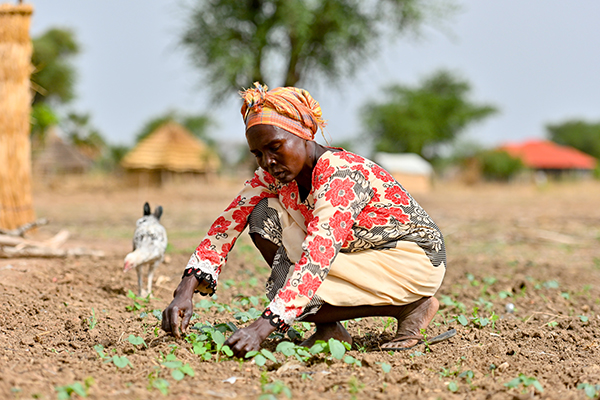
Anok plants fast-growing, drought and flood-tolerant vegetables that reach maturity in as little as 45 days, to make the most of the brief spells when growing conditions are favourable. Credit: Christian Aid/David Macharia
Christian Aid’s local partner also trained Anok and her neighbours how to grow food in a changing climate. With seeds, tools and training, Anok has planted flood-resilient and drought-tolerant vegetables that are also fast-growing, reaching maturity in as little as 45 days, to make the most of the brief spells when growing conditions are favourable. These crops will feed their families, and any surplus can be sold for cash.
Anok added: “We used to go and collect leaves from the wild trees to eat but we aren’t collecting them anymore because we are growing vegetables. We were given seeds like kale, jute mallow and okra. We sell some to get cash for the children’s school fees and for medical treatment.”
Thanks to the support of Christian Aid’s local partners, Anok’s land is now better protected from flooding, and she is also rearing chickens and selling her groundnut paste to bring in a much-needed income.
Anok also hopes to start a Village Savings and Loans Association (similar to a credit union) so that farmers can save together, share knowledge and support one another through difficult seasons. It’s one more way Anok wants to pass on what she’s learned.
Despite the challenges that Anok faces, she is determined to succeed. “I work hard for two reasons. One, to put something on the table for my family to eat and two, to earn enough money to pay the fees to keep my children in school. If I get a good harvest, this is what I will do.”
Farming families like Anok’s continue to feel the harsh effects of the climate crisis – with growing seasons disrupted, rains arriving late and floods becoming more devastating. It means that growing enough food is a huge challenge for many families already living in extreme poverty.
Your support can help fund the training and practical solutions that farmers like Anok need to reduce hunger and malnutrition, protect their land and their harvests and keep going when weather patterns become more unpredictable.
- To download Christian Aid’s free Harvest resources, to book a speak to visit your church or school, or to make a donation in support of the Harvest appeal, please visit caid.ie
Leviticus 19: 9-10
“When you reap the harvest of your land, do not reap to the very edges of your field or gather the gleanings of your harvest. Do not go over your vineyard a second time or pick up the grapes that have fallen. Leave them for the poor and the foreigner.”
Deuteronomy 24: 19
“When you are harvesting in your field and you overlook a sheaf, do not go back to get it. Leave it for the foreigner, the fatherless and the widow.”


Site Directory
- Home
- All Aboard Year 3 Resources
- Cookie Policy
- Privacy Policy
- About us
- News
- Parishes
- Agherton
- Ahoghill and Portglenone
- Antrim
- Ardclinis, Tickmacrevan, Layde and Cushendun
- Armoy, Loughguile and Drumtullagh
- Ballinderry
- Ballintoy, Dunseverick and Rathlin
- Ballymacash
- Ballymena (Kilconriola) and Ballyclug
- Ballymoney, Finvoy and Rasharkin
- Ballynure and Ballyeaston (Ballyclare)
- Ballyrashane & Kildollagh
- Ballywillan, Portrush
- Belfast Cathedral
- Billy & Derrykeighan
- Blackstaff Mission Area
- Broomhedge
- Carnmoney
- Carrickfergus
- Christ Church, Lisburn
- Cloughfern
- Coleraine
- Connor and Antrim St Patrick
- Craigs, Dunaghy and Killagan
- Derriaghy
- Derryvolgie
- Drummaul, Duneane and Ballyscullion
- Dunluce
- Dunmurry
- Eglantine
- Finaghy and Upper Malone
- Glenavy
- Glencairn
- Greenisland
- Holy Trinity and St Silas with Immanuel
- Jordanstown
- Kilbride
- Kilmakee Parish
- Kilroot and Templecorran
- Kilwaughter and Cairncastle with All Saints Craigyhill
- Lambeg
- Larne & Inver, Glynn & Raloo
- Lisburn Cathedral
- Lisburn St Paul’s
- Magheragall
- Mallusk
- Malone
- Monkstown
- Mossley
- Muckamore and Killead
- Ramoan and Culfeightrin (Ballycastle)
- Rathcoole
- Saint Katharine
- Skerry, Rathcavan & Newtowncrommelin
- St Bartholomew’s, Stranmillis
- St George’s
- St Mark (Ballysillan)
- St Mary with Holy Redeemer
- St Matthew’s, Shankill
- St Michael Belfast
- St Paul & St Barnabas
- St Peter & St James
- St Stephen and St Luke (Lower Falls)
- St Thomas’s
- Stoneyford and Gartree
- Templepatrick and Donegore
- The United Parishes of St Nicholas and All Saints
- Upper Falls
- Whitehead & Islandmagee
- Whitehouse St Ninian
- Whiterock
- Woodburn
- Children/Youth
- Support
- Connor Connections
- Vacancies
- Links
Follow us online
© Copyright The Church of Ireland Diocese of Connor 2026 | Web Design by LD2.digital