Retired school principal addresses retired clergy meeting
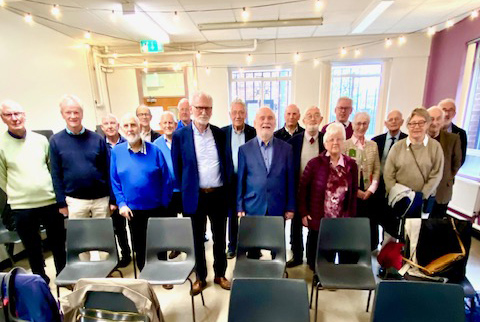
Members of the Retired Clergy Association (NI) and the Methodist Retired Clergy Fellowship are pictured at their recent meeting in the Cathedral Hall of St Anne’s with the guest speaker, John Stevenson (front row, fourth left). Photo: Canon Jim Campbell
Report by Canon Jim Campbell
The Retired Clergy Association (NI)’s first meeting of the autumn season took place in the Cathedral Hall at St Anne’s, Belfast, on Thursday September 24.
Members were joined by some colleagues from the Methodist Retired Clergy Fellowship and after refreshments, heard a talk from John Stevenson, retired headmaster of Sullivan Upper Grammar School, Holywood.
Mr Stevenson spoke on some of the developments in the field of education during his career (which began as a teacher of biology in Dalriada Grammar School, Ballymoney) and also on some of the latest challenges which have arisen since his retirement.
Mr Stevenson believed that education had two main purposes – to develop the individual as a rounded person, realising their potential, and to provide what government and society needed for the wellbeing of all.
He referred to the immense changes which had taken place in teaching, ranging from the traditional method of the teacher imparting knowledge from the front of the classroom to the more recent teaching methods of pupils discovering aspects of a subject by the use of Google, iPad, YouTube and interactive activities, such as conducting interviews and making visual presentations and the use of the whiteboard.
Mr Stevenson drew attention to new research which indicated the importance of writing skills as a means of developing the brain to make vital connections with motor abilities. Therefore, he said, reading and literacy must always be at the core of education, while there still remained the necessity of developing digital literacy.
He went on to discuss the challenges posed by the increasing number of ‘statemented’ pupils having special educational needs, including those with Autism, and the lack of educational psychologists in the state system to assess them, which led to increasing private assessments for parents who could afford it, thus leaving children from poorer families disadvantaged.
However, the present fear is that there are insufficient resources to help the many children who have been identified and there is also a concern for the small number of ‘gifted and talented’ children who needed teaching and learning to match their abilities.
Mr Stevenson moved on to discuss the impact of AI which could produce immediate programmes and educational policies, but he asked if AI was doing the thinking, what were the pupils doing? Cheating was a strong possibility and how could plagiarism be identified? He asserted that pupils must be taught to think properly!
He referred to academic selection and its negative effects in some cases, and also the need to retain some kind of assessment and internal selection to allow teaching and learning to function properly.
Finally, he emphasised the need to encourage the involvement of parents in their children’s education by showing them what their school was doing and inviting them to be involved in the learning process. When this happened and parents brought a positive supporting attitude, then educational achievement was greatly increased.
Mr Stevenson’s talk was both highly informative and entertaining, with many personal anecdotes added. On behalf of all present, Bishop Patrick Rooke, RCA (NI) Chairman, expressed thanks to Mr Stevenson, and Canon Raymond Fox presented him with a gift voucher.
Before the meeting closed, Canon Fox referred to the recent launch of his latest book, entitled ‘Hourglass,’ a collection of his poetry and biographical reflections which was now available to purchase, with all proceeds supporting the Dean of Belfast’s 2026 Black Santa Appeal in this, its 50th anniversary year.

Site Directory
- Home
- All Aboard Year 3 Resources
- Cookie Policy
- Privacy Policy
- About us
- News
- Parishes
- Agherton
- Ahoghill and Portglenone
- Antrim
- Ardclinis, Tickmacrevan, Layde and Cushendun
- Armoy, Loughguile and Drumtullagh
- Ballinderry
- Ballintoy, Dunseverick and Rathlin
- Ballymacash
- Ballymena (Kilconriola) and Ballyclug
- Ballymoney, Finvoy and Rasharkin
- Ballynure and Ballyeaston (Ballyclare)
- Ballyrashane & Kildollagh
- Ballywillan, Portrush
- Belfast Cathedral
- Billy & Derrykeighan
- Blackstaff Mission Area
- Broomhedge
- Carnmoney
- Carrickfergus
- Christ Church, Lisburn
- Cloughfern
- Coleraine
- Connor and Antrim St Patrick
- Craigs, Dunaghy and Killagan
- Derriaghy
- Derryvolgie
- Drummaul, Duneane and Ballyscullion
- Dunluce
- Dunmurry
- Eglantine
- Finaghy and Upper Malone
- Glenavy
- Glencairn
- Greenisland
- Holy Trinity and St Silas with Immanuel
- Jordanstown
- Kilbride
- Kilmakee Parish
- Kilroot and Templecorran
- Kilwaughter and Cairncastle with All Saints Craigyhill
- Lambeg
- Larne & Inver, Glynn & Raloo
- Lisburn Cathedral
- Lisburn St Paul’s
- Magheragall
- Mallusk
- Malone
- Monkstown
- Mossley
- Muckamore and Killead
- Ramoan and Culfeightrin (Ballycastle)
- Rathcoole
- Saint Katharine
- Skerry, Rathcavan & Newtowncrommelin
- St Bartholomew’s, Stranmillis
- St George’s
- St Mark (Ballysillan)
- St Mary with Holy Redeemer
- St Matthew’s, Shankill
- St Michael Belfast
- St Paul & St Barnabas
- St Peter & St James
- St Stephen and St Luke (Lower Falls)
- St Thomas’s
- Stoneyford and Gartree
- Templepatrick and Donegore
- The United Parishes of St Nicholas and All Saints
- Upper Falls
- Whitehead & Islandmagee
- Whitehouse St Ninian
- Whiterock
- Woodburn
- Children/Youth
- Support
- Connor Connections
- Vacancies
- Links
Follow us online
© Copyright The Church of Ireland Diocese of Connor 2026 | Web Design by LD2.digital